
Playing with Sea Lions
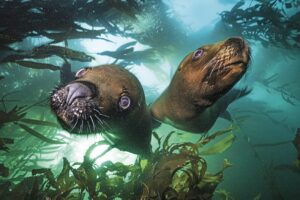 Along sections of the California coast, dense forests of giant kelp create towering underwater landscapes. Long brown fronds rise from rocky bottom to the surface, forming columns that sway in the surge. Light filters through the canopy in green and gold shafts. These forests provide shelter and hunting ground for many species, including one of the most energetic and curious inhabitants of the region, the California sea lion. On a calm day at a kelp site near the Channel Islands, a group of divers descended through the top layer of kelp into open corridors between the plants. Crabs moved across the holdfasts, bright orange garibaldi hovered over rocks, and small schools of fish wove between the blades. Before long, the first bark from the surface carried faintly down through the water. Young sea lions arrived in loose formation, moving with effortless speed through the kelp. Instead of avoiding the divers, they began to loop and spin around them. One animal grabbed a strand of kelp and shook it like a rope toy. Another swam directly toward a camera dome, rolled at the last second, and passed inverted with whiskers almost brushing the glass.
Observers and photographers who have worked frequently in these forests describe the same pattern. When divers remain calm and stay near the bottom or in a clearing, sea lions often approach repeatedly, sometimes imitating movements such as spins or rolls. Reports from sites in California and Mexico describe individuals dropping shells or sea stars in front of divers in what appears to be an invitation to play.
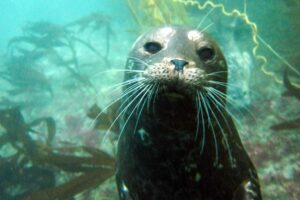 In this particular kelp forest, the visibility was good enough for wide views. Sunbeams cut down through the canopy. When a sea lion passed through one of these beams, its body looked almost metallic against the darker background. Some divers focused on close portraits, trying to capture direct eye contact and the texture of whiskers. Others framed wide scenes in which a single sea lion dashed between tall kelp plants, adding a sense of scale to the forest. Despite their playful behaviour, sea lions remain powerful wild animals that deserve caution and respect. Wildlife agencies and local guidelines generally advise divers not to chase them, not to block exits, and to avoid disturbing haul out sites, especially during breeding seasons. The most memorable images from encounters of this kind usually share a few elements. There is a clear subject, often a curious juvenile, a background of kelp trunks and sunbeams that gives depth, and a hint of motion that shows how fast these animals can move when they choose to turn the kelp forest into a game arena.
Tell us about your thoughtsWrite message