
Coral Spawning on the Great Barrier Reef
 On a warm November evening a liveaboard vessel rested over an outer section of the Great Barrier Reef. Water temperature had stayed above roughly twenty seven degrees for weeks, and the first full moon of late spring had just passed. These conditions are known to trigger one of the most spectacular events on the reef, the annual mass coral spawning.
Long before sunset, crew members prepared for a night dive. Tanks were filled, cameras checked, strobes tested, and focus lights attached. Divers received a very clear briefing, because the timing of spawning can be precise but still uncertain. Many coral species release eggs and sperm together during only a few nights each year, often two to six days after the November full moon. Just after nightfall the group slipped into the water and followed a guide to a section of branching coral. The first minutes felt like a normal night dive. Torch beams swept over parrotfish sleeping in mucus cocoons and tiny shrimp hiding in crevices. Suspended particles drifted through the light like dust in a dark room.

Then one diver noticed small pale spheres beginning to appear on a single colony of coral. Tiny bundles pushed out from the polyps, hovered for an instant, then started to rise toward the surface. Within a few minutes, many colonies joined in. What had been a quiet reef turned into a slow underwater snowstorm.
The water column filled with millions of buoyant egg and sperm bundles. Visibility dropped as the spawn thickened. Buoyancy control became critical, because any careless fin movement stirred up clouds of material and sediment. Photographers tried to balance exposure, focus, and composition while surrounded by drifting life. Some framed wide scenes of divers outlined against a pink haze. Others moved close to individual colonies that continued to release perfect spheres like glowing beads.
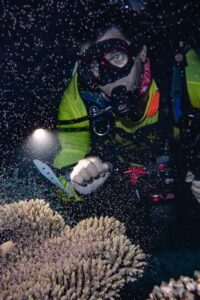
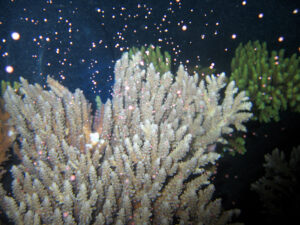 From a scientific perspective this event is more than a visual spectacle. Coral mass spawning is a key moment for reef renewal, because it creates enormous numbers of larvae that may settle and grow into new colonies. Observations along the reef have shown that many species synchronise their spawning to increase the chance of successful fertilisation and dispersal.
After the dive, the deck of the vessel smelled faintly of coral and plankton. Divers compared images and video clips, aware that no single frame could fully capture what had just happened. The real subject of the dive was not any individual organism but the entire reef releasing its future into the water at once.
Tell us about your thoughtsWrite message